
The Mirage of the Rising Sign: Why Your Ascendant Isn’t Your Face
When astrology becomes costume, we mistake the mask for the actor.
In the golden age of social media astrology, the Ascendant has become a kind of astrological selfie filter. It’s not uncommon to hear someone say, “Well, I’m an Aries rising, so of course I’m intense,” or, “She’s a Libra rising—you can tell by the cheekbones.” The rising sign has been over-inflated into an aesthetic category, a shortcut for describing how someone looks or acts, often before we even know their name. But as any serious astrologer—or psychoanalyst—would point out, this is a fundamental misreading of what the Ascendant actually is.
Despite its prominent placement on the natal chart, the Ascendant isn’t the foundation of the personality, and certainly not the sculptor of the body. It’s not who we are, but who we attempt to become in response to the world’s gaze. It’s a horizon line—a directional marker, not solid ground. And like any horizon, it appears most vividly when we’ve lost touch with our footing. We grab for it in moments of anxiety, unfamiliarity, or exposure. It’s what we perform when we’re uncertain of what to feel.
In contrast, the real anchors of the psyche—the Sun and the Moon—operate beneath that reactive threshold. The Sun, with its constant gravitational pull, centers the identity. It governs the self we strive to actualize, the central arc of becoming. The Moon, ever shifting yet cyclical, defines our emotional metabolism: how we respond, absorb, and digest the experiences of life. Together, they don’t mask the self—they reveal it. They ground us in something enduring, whether or not we’re aware of it.
So when someone insists that their Leo rising makes them flamboyant or that a Capricorn Ascendant explains their bone structure, it’s worth asking: is this self-knowledge, or just a well-rehearsed defense?
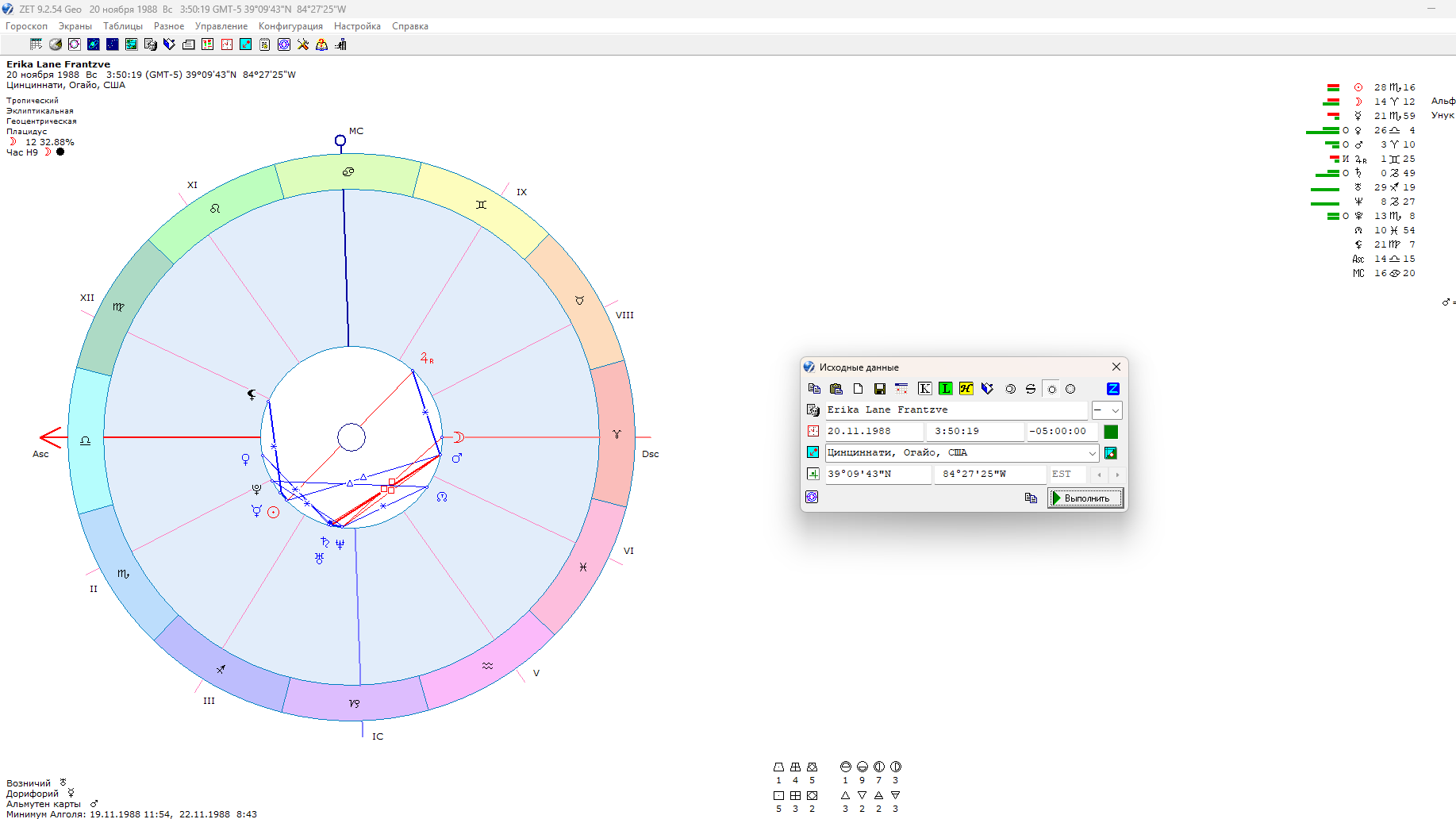
Erika Kirk real birth time
Consider Erika Kirck. With a Libra Ascendant and a Cancer Midheaven, she would seem to check every box of archetypal femininity: balanced, elegant, maternal, even pious. A model. A Christian mother figure. A woman of gentle conviction. But astrological image rarely matches astrological substance. Beneath this curated public mask lies the truth of her Scorpio Sun and Moon.
And it shows. Not in how she walks into a room, but in how she dominates it psychologically. This isn’t Libra’s grace or Cancer’s nurturing impulse—it’s Scorpio’s instinct for power, its psychic X-ray, its absolute intolerance for weakness or vulnerability. Scorpio doesn’t need to be adored; it needs to be in control. And this control often comes cloaked in something palatable—like Libra's charm or Cancer's moral veneer.
This is the paradox the rising sign presents: it’s the mask we wear so convincingly that we start to believe it ourselves. But astrology, when practiced with rigor, invites us to look deeper. To ask not just what do I appear to be, but where do I come from inwardly? What fuels me? What do I feel when I’m alone? What patterns do I repeat in the dark?
The Ascendant is a brilliant stage light—but it is not the actor, and certainly not the script. If you want to know who someone truly is, don’t read their horizon. Read their core. Look where the light lives and where the tides turn—always, the Sun and Moon.